SCENARIO EXPLORATION

Explore the scenario.
Understand the trade-offs.

Use the digital model to examine potential exposure and consider change. Raqib Digital Twin helps teams discuss what-if scenarios and possible consequences before decisions move toward real operations.

Discuss your priorities
RAQIB / PLATFORM PERSPECTIVE
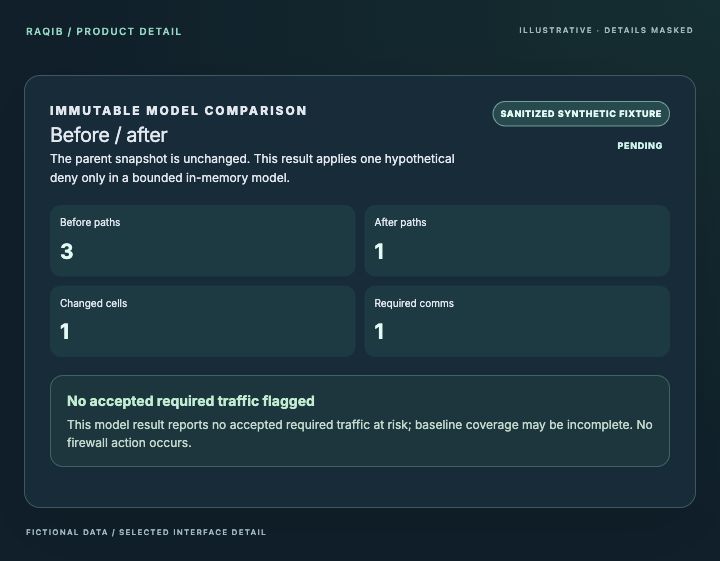
Fictional before-and-after digital model comparison; no live system changes.

Selected interface detail · Fictional data · Identifiers masked

01What-if perspective02Modeled consequences03Informed preparation
01

Make a possibility specific enough to examine.

“What if?” becomes useful when it describes a situation the team needs to understand. A question about a boundary or a connection can reveal how different specialists view the same environment. Scenario exploration gives those perspectives a shared digital setting.

Raqib Digital Twin supports examination of potential paths and proposed changes within the represented environment. The team can explore a baseline and an alternative, then focus on the relationships that make the difference meaningful.

02

Explore the implications behind the picture.

Suppose a team is considering a restriction between two industrial zones. The question concerns both the potential exposure and the communications needed by the operation. A comparison helps specialists identify where the intended benefit and the operational dependency meet.

AI-supported recommendations help interpret that comparison and suggest questions for review. The model’s scope and assumptions remain part of the analysis. This keeps the discussion grounded in what is represented and identifies where additional evidence or specialist validation would improve confidence.

03

Use the result to prepare a better next step.

The outcome of an exploration can be a more precise question, a better-defined alternative or a focused validation plan. Each is useful when it gives the responsible team a clear reason to act and an understanding of what still needs to be established.

Scenario exploration supports preparedness; it does not predict a real incident with certainty. Your people decide how to interpret the results and authorize any subsequent activity. Raqib helps make that judgment better informed by connecting the proposed action to the industrial context behind it.

A DIGITAL TWIN DEMONSTRATION

What changes when we change a boundary?

Use a fictional facility to compare a baseline with a proposed segmentation change. Examine the modeled implications and decide what would need validation.

Explore scenario planning
01

Start with the facility

Identify the industrial zones, device roles and connections involved.

02

Compare the alternatives

Examine modeled connectivity before and after the proposed boundary.

03

Define what to validate

Review assumptions and dependencies with your security and engineering teams.

See Digital Twin in a private demo

A BETTER QUESTION BEFORE A BIGGER DECISION

Give “what if” a clear frame of reference.

Scenario exploration makes a proposed change easier to examine. Start with a defined question, compare it with the baseline model and consider which relationships may be affected. Raqib helps teams bring potential exposure and operational dependencies into the same review.

Frame the question

Choose a concern or proposed change and identify what the team needs to understand. A focused question gives the comparison a useful purpose.

Examine alternatives

Compare modeled conditions and review the relationships that change. Consider security implications alongside the services operations depend on.

Prepare a recommendation

Bring the assumptions, potential implications and open questions together for specialist review. Use the result to define the next validation step.

IN PRACTICE

Explore a proposed boundary

Before changing a network boundary, a team can examine how the proposal would alter the relationships represented in the twin. The comparison helps identify both the intended security effect and the operational questions that need further investigation.

A CLEARER UNDERSTANDING

The questions worth asking.

How does this differ from scenario planning?

Exploration is the capability for examining a modeled question. Scenario planning applies that capability to a broader decision: selecting alternatives, weighing implications and defining what should be validated next.

Does a modeled result predict an attack?

It describes a possibility within the model and its assumptions. It helps prioritize investigation; a confirmed finding requires supporting observation or validation appropriate to the claim.

LET’S START WITH YOUR PRIORITIES

Which what-if question matters most to your team?

Bring the challenge your team needs to address. Explore how Raqib fits your environment and agree on a focused next step with our team.

Start the conversation