INDUSTRIAL ASSET CONTEXT

Every device has a role.
See the wider operation.

PLCs, operator stations, historians and field instruments are more than entries in an inventory. Raqib Digital Twin brings their industrial roles into a connected perspective on the environment.

Discuss your priorities
RAQIB / PLATFORM PERSPECTIVE
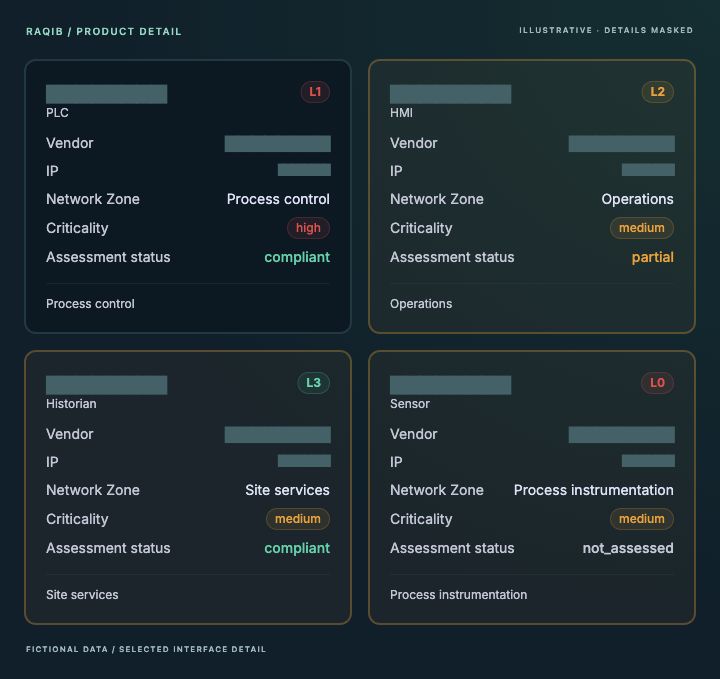
Fictional PLC, HMI, historian and sensor cards with identifying details masked.

Selected interface detail · Fictional data · Identifiers masked

01Industrial devices02Asset relationships03Operational perspective
01

Read the industrial environment through its roles.

A PLC controls a process, an operator station supports supervision, and a historian provides a record of industrial activity. Understanding these roles helps explain why the same technical concern can have different significance across a facility. The role of an asset gives its security context meaning.

Raqib Digital Twin brings devices and their modeled relationships into a connected representation. Security and engineering can discuss the same environment while contributing different expertise about exposure, dependencies and the responsibilities of keeping the operation running.

02

See the relationships around the device.

An asset’s surroundings matter: the zone it belongs to, the systems it exchanges information with and the functions represented around it. A connected model helps teams examine these relationships together and understand where a question extends beyond one device.

For example, investigating an engineering workstation may involve understanding its relationship to control equipment and the boundaries shown in the model. That context helps specialists decide which connections deserve closer review and what additional information would make the assessment more useful.

03

Turn a shared model into a better investigation.

The representation creates a common reference for exploring scenarios and discussing change. Agentic analysis helps interpret modeled relationships and propose areas for attention. Engineering knowledge remains essential to understanding the practical significance of the findings.

Teams should consider which assets and connections are represented, what assumptions have been made and where information needs validation. This gives the model a clear role in the decision: helping people ask more precise questions and prepare a stronger case for the next step.

A DIGITAL TWIN DEMONSTRATION

What changes when we change a boundary?

Use a fictional facility to compare a baseline with a proposed segmentation change. Examine the modeled implications and decide what would need validation.

Explore scenario planning
01

Start with the facility

Identify the industrial zones, device roles and connections involved.

02

Compare the alternatives

Examine modeled connectivity before and after the proposed boundary.

03

Define what to validate

Review assumptions and dependencies with your security and engineering teams.

See Digital Twin in a private demo

VISIBILITY WITH OPERATIONAL MEANING

Understand what an asset supports, and what depends on it.

An inventory identifies equipment. Industrial context explains why it matters. By relating devices to zones, connections and operational roles, Raqib Digital Twin gives security and engineering a common model for examining where a concern could have wider consequences.

Recognize industrial roles

View controllers, operator stations, historians and field devices in relation to the work they support. Bring operational meaning into technical assessments.

Examine dependencies

Consider how a device relates to neighboring systems and shared services. Identify questions that an isolated asset record would leave unanswered.

Direct investigation

Use the modeled environment to focus exposure analysis and proposed improvements. Give specialists a clearer basis for choosing what to examine first.

IN PRACTICE

The same finding can mean different things

A concern affecting an engineering workstation may have different implications from one affecting an isolated monitoring device. The connected model helps teams examine those differences before assigning priority or deciding what additional validation is needed.

A CLEARER UNDERSTANDING

The questions worth asking.

Is this a replacement for operational expertise?

The model gives specialists a shared reference. Site knowledge remains essential to understanding process dependencies, maintenance constraints and the significance of a potential issue.

How should we interpret the representation?

Its usefulness depends on the information and relationships represented. Teams review its scope and assumptions before relying on it for an investigation or a proposed change.

LET’S START WITH YOUR PRIORITIES

Which assets define the resilience of your operation?

Bring the challenge your team needs to address. Explore how Raqib fits your environment and agree on a focused next step with our team.

Start the conversation